

Agate Falls is located on the Middle Branch of the Ontonagon River in the western UP of Michigan. The Ontonagon River is in the western Upper Peninsula of Michigan and has multiple headwaters that form the West, South/South, Middle, and East branches of the river. The Middle Branch’s headwaters are near Crooked Lake (part of the Sylvania Wilderness in the Ottawa National Forest), west of Watersmeet. The East and Middle Branches converge near a roadside stop on US-45. Then a bit further downstream, all the branches converge east of the Victoria Dam, where they then head south toward Lake Superior.

Location of Agate Falls
History of Agate Falls
The United States acquired legal control of the lands that Ontonagon river flows through by signing the Treaty of La Pointe in 1842 with Ojibwe peoples. The Ontonagon Boulder is another important part of the story about the river and relationships between Ojibwe people and Americans in the region. But that’s a story for another time.
In the decades following the treaty, new industries including mining (copper and iron) and logging developed. During the logging era, the Ontonagon Rive served as a highway transporting logs to the mills at Ontonagon Harbor (present-day Ontonagon, MI). During those years, if you were at Agate Falls, you’d see a parade of logs dropping over the falls. According to the sign on site, original accounts describe the falls as sheer with a bridal veil affect, but through time, logs chipped away at the bedrock producing the stepped falls that we admire in the present. Other accounts describe dynamite being used on the falls to smooth out the log’s journey and make the drop less sheer. By the late 1800s, railroads were replacing rivers as the most common form of transportation. A railroad bridge was created over the falls in 1899.
Agate Falls has a been a tourist attraction for almost a century. In 1935, a resort with cottages and a tavern opened at the falls. In the resort’s early years, there was a staircase with over 125 steps leading down to the falls. By 1955, a motel replaced the cottages. By the early 1970s, the original tavern building had burned and the motel was converted to a bar. I’m really interested in learning more about this history. I’ve just started looking into it, so at this point I don’t have more to share. But if anyone has any information, I’d love to hear it!
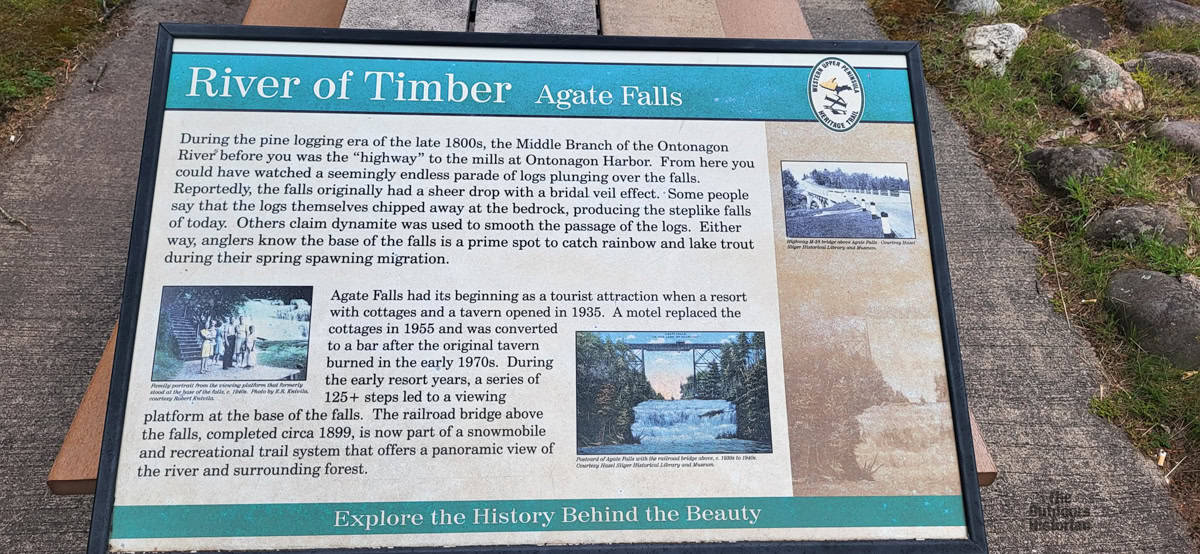
From the sign at the rest area:
River of Timber
Agate FallsDuring the pine logging era of the late 1800s, the Middle Branch of the Ontonagon River before you was the “highway” to the mills at Ontonagon Harbor. From here you could have watched a seemingly endless parade of logs plunging over the falls. Reportedly, the falls originally had a sheer drop with a bridal veil effect. Some people say that the logs themselves chipped away at the bedrock, producing the steplike falls of today. Others claim dynamite was used to smooth the passage of the logs. Either way, anglers know the base of the falls is a prime spot to catch rainbow and lake trout during their spring spawning migration.
Agate Falls had its beginning as a tourist attraction when a resort with cottages and a tavern opened in 1935. A motel replaced the cottages in 1955 and was converted to a bar after the original tavern burned in the early 1970s. During the early resort years, a series of 125+ steps led to a viewing platform at the base of the falls. The railroad bridge above the falls, completed circa 1899, is now part of a snowmobile and recreational trail system that offers a panoramic view of the river and surrounding forest.
Agate Falls Today
Today, many sections of the Ontonagon are classified as a National Wild and Scenic River, including the upper courses of the East and Middle branches in the Ottawa National Forest, the entire Cisco branch, and the middle section of the West Branch from Cascade Falls to Victoria Reservoir. There is a roadside stop on M-28 near Agate Falls that is maintained by MDOT. It has outhouses and a water pump. There is sign about the history of the falls and a short accessible path to an overlook at the top of the falls. While you can see water running over the edge of the falls, you don’t get a good view of the actual falls.

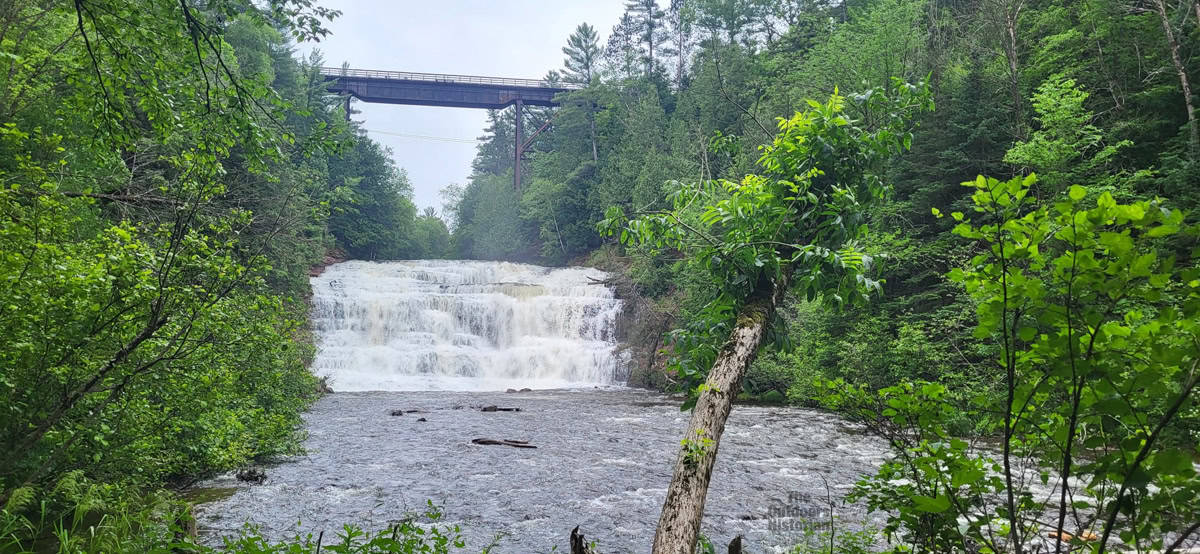


There are unofficial footpaths that head up to the old railroad bridge, which is now part of an ORV and snowmobile trail system. There are no more stairs to the bottom of the falls. However, there are also several unofficial footpaths leading down to the base of the falls. This is where you get the best view. However, the paths are narrow and steep in portions. We tended to stay to the right (several paths split to the left and had very steep descents) and we slowly meandered are way down to the bottom of the falls.
The base of the fall is a popular fishing spot for rainbow and lake trout during the spring spawning season. There was a mix of anglers and visitors admiring the beauty of the falls when we visited this past June.

If you are visiting Agate Falls, it’s definitely worth it to check out Bond Falls! Other nearby sites include O-kun-de-kun Falls, Old Victoria, the Victoria Dam, Sturgeon Falls, Silver Mountain, and many small waterfalls. Agate Falls is surrounded by the Ottawa National Forest, so there’s no shortage of places to explore.
